It sounds obvious, right? Yet, this short line can decide whether your answer earns full marks or misses the point entirely.
In every classroom, from Manila to Manchester, students often lose points not because they don’t know the answer but because they misunderstood the question. That’s where careful reading becomes a superpower.
Let’s explore how this one habit can transform your learning, improve your exam scores, and even boost your communication skills for life.
Why “Read the Statement Carefully” Matters More Than You Think
Imagine this: you’re in the middle of your English exam. You’ve got 20 minutes left and a tricky instruction that says,
“Write only two advantages of online learning.”
You’re in a rush, so you list three.
When the paper is returned, you lose points not for your ideas, but because you didn’t follow the instruction.
That’s what happens when we don’t slow down and read the statement carefully.
The Power of Careful Reading
Careful reading isn’t just about seeing words it’s about understanding what they truly ask for. Every exam question has hidden clues:
- Action words tell you what to do (e.g., explain, compare, describe, evaluate).
- Limits tell you how much to write (only two advantages, write in 50 words).
- Focus words tell you the exact topic (advantages of online learning not disadvantages).
When you spot these details, you answer smarter and faster.
Quick Fact
According to the Philippine Department of Education’s 2024 Study Skills Survey, over 43% of students lose marks due to misreading or misunderstanding instructions not because they lack knowledge.
That’s nearly half of students failing to reach their potential, simply because they didn’t take that extra 10 seconds to reread a question.
Understanding What “Read the Statement Carefully” Really Means
It’s easy to think it just means “read slowly,” but there’s more to it.
Reading the statement carefully means:
- Understanding what the question is really asking.
- Identifying the keywords that guide your answer.
- Avoiding assumptions.
- Double-checking for tricky wording like “not,” “except,” or “only.”
Let’s break that down.
1. Understand the Purpose
Ask yourself: What does the question want from me?
For example:
“Explain why recycling is important.”
That means you need to give reasons, not just describe what recycling is.
2. Identify the Keywords
Underline or highlight key words like “why,” “how,” “advantages,” “disadvantages.” They tell you what to focus on.
3. Avoid Assumptions
Don’t assume it’s the same question as last time. Many exam questions look similar but twist one small word that changes everything.
4. Watch for Tricky Words
Words like not, except, rarely, mostly, or all completely change meaning.
“Which of the following is not an example of renewable energy?”
If you miss that one “not,” your entire answer flips upside down.
How to Read a Question Carefully in Exams
This is where most students ask: Okay, but how do I actually do it?
Here’s a step-by-step method teachers swear by and it works in any subject.
Step 1: Read the Whole Question First
Don’t rush to write the answer after reading the first few words. Read the full question once to get the complete idea.
Step 2: Circle or Underline Keywords
Mark the action words (like list, explain, define), content words (like climate change, character, formula), and limiting words (two examples, 100 words, main reason).
Step 3: Paraphrase It in Your Mind
Before answering, restate the question in your own words:
“Oh, they want me to explain why recycling helps the environment.”
This ensures your brain processes it clearly.
Step 4: Read It Again Before Writing
Even one reread can help you spot something you missed a number limit, a time frame, or a hidden word like not.
Step 5: Double-Check After Answering
Before submitting, go back to see if your answer fits the question exactly. This simple habit can fix careless mistakes and save grades.
Real Classroom Moment
When I was coaching my debate students in Quezon City, one of them let’s call her Andrea always wrote brilliant answers, but she kept missing the point of the motion.
The topic was:
“This house believes that social media does more harm than good.”
She spent five minutes listing the benefits of social media. Her logic was solid, but she forgot the key part: the statement asked for harm, not benefits.
When I reminded her to “read the statement carefully,” she laughed, reread, and said,
“Sir, I thought I understood but I didn’t actually see what it was asking.”
That moment turned her around. By her next competition, she was double-checking every motion and winning.
Sometimes, the biggest improvement doesn’t come from learning new facts, but from reading smarter.
What Type of Sentence Is “Read the Instructions Carefully”?
Grammatically, this is an imperative sentence a type of sentence that gives a command or direction.
It doesn’t ask for information or share feelings. Instead, it tells you what to do just like a teacher’s instruction.
Other examples of imperative sentences include:
- “Close your books.”
- “Write your name on the paper.”
- “Do not start until I say go.”
When we see “Read the statement carefully,” it’s not a suggestion it’s a command meant to protect you from mistakes.
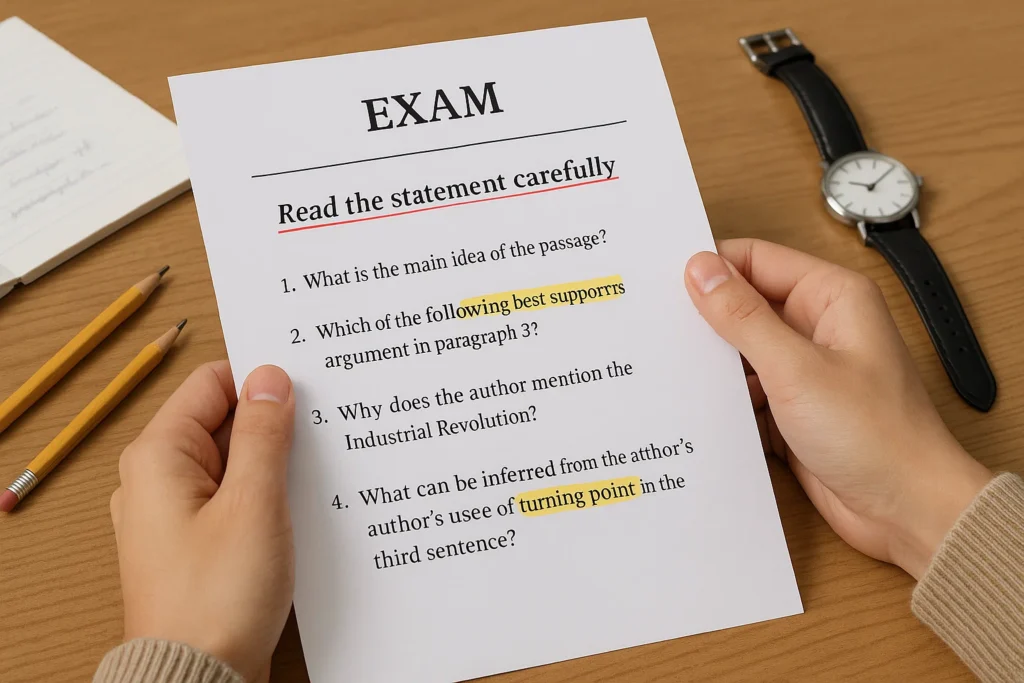
The Psychology Behind Careful Reading
Careful reading isn’t just a habit it’s a mental discipline.
1. Focus and Attention
Our brains love shortcuts. When we see familiar words, we think we know the question already. That’s called cognitive bias.
Careful readers pause to override that bias and check the full meaning.
2. Working Memory
Psychologists say our short-term memory can hold only 5–7 chunks of information at once. When you rush, you overload it and forget key words.
Reading carefully helps your brain store details correctly.
3. Stress Management
During exams, stress makes us hurry. But reading slowly helps lower anxiety by giving you control and clarity.
When you feel in control, you think better and that confidence shows in your answers.
How to Build the Habit of Reading Carefully
Like any skill, it takes practice. Try these strategies daily not just before tests.
1. Practice Active Reading
When reading questions, underline, circle, or highlight important parts.
Even if it’s just your own notes, train your eyes to catch the action words.
2. Pause Before You Write
Count to three before you start writing an answer. It helps your brain process the question fully.
3. Train With Past Papers
Go through old exams and look for where you might have misunderstood. Rewrite those questions correctly.
4. Create a “Careful Reading” Checklist
Before every quiz or exam:
☑ Did I read the full question?
☑ Did I underline keywords?
☑ Did I check for “not” or “except”?
☑ Did I answer exactly what was asked?
5. Reflect on Mistakes
When you lose points, don’t just memorize the right answer. Ask: Did I misread something? That reflection turns errors into growth.
Examples of Statement Questions
A statement question usually presents information and asks you to decide if it’s true or false, or to analyze it.
Here are a few examples:
| Statement Question | Task | Tip |
|---|---|---|
| “The sun rises in the east.” | Decide if true or false. | Watch for “always,” “never,” “not.” |
| “All mammals lay eggs.” | Identify falsehood. | Notice the word “all.” |
| “Recycling reduces pollution.” | Explain why. | Support your statement with reason. |
| “The Philippines is in Southeast Asia.” | True or false question. | Straightforward factual check. |
Pro Tip: In science and English exams, look for qualifying words like most, sometimes, rarely, all, none. They often decide whether a statement is true or false.
The Difference Between Reading and Understanding
Reading words is easy. Understanding them takes focus.
When students rush, they often answer based on what they think the question says not what it actually says.
For example:
“List three causes of air pollution.”
Some students might write about effects of air pollution instead simply because their brain associated the word “pollution” with effects.
To truly understand:
- Read the question aloud in your head.
- Break it into smaller parts.
- Recheck if your answer matches the command.
That’s what careful readers do they connect reading and comprehension before writing.
Why Teachers Emphasize It Constantly
Teachers don’t repeat “Read the statement carefully” to annoy you. They say it because they know how human attention works.
A study from the University of the Philippines Open Learning Institute (2025) showed that students who paused to reread instructions scored 18–25% higher than those who didn’t.
That means even the best essay writer can lose points by skipping this basic step. Teachers emphasize it because it’s a shortcut to accuracy and accuracy leads to confidence.
How This Skill Helps Beyond School
Careful reading isn’t just for tests. It shapes how you handle information in everyday life.
1. At Work
When your boss sends an email with detailed instructions, reading carefully avoids mistakes and shows professionalism.
2. In Daily Life
From reading terms on a form to following recipes or directions misreading can cause real trouble (imagine confusing “tablespoon” with “teaspoon” in cooking!).
3. In Debates or Conversations
When you listen or read someone’s argument carefully, you respond smarter. That’s what debate training is all about understanding before answering.
4. In Social Media
People often argue online because they didn’t read the full post or article. Reading carefully helps you stay informed and avoid misunderstandings.
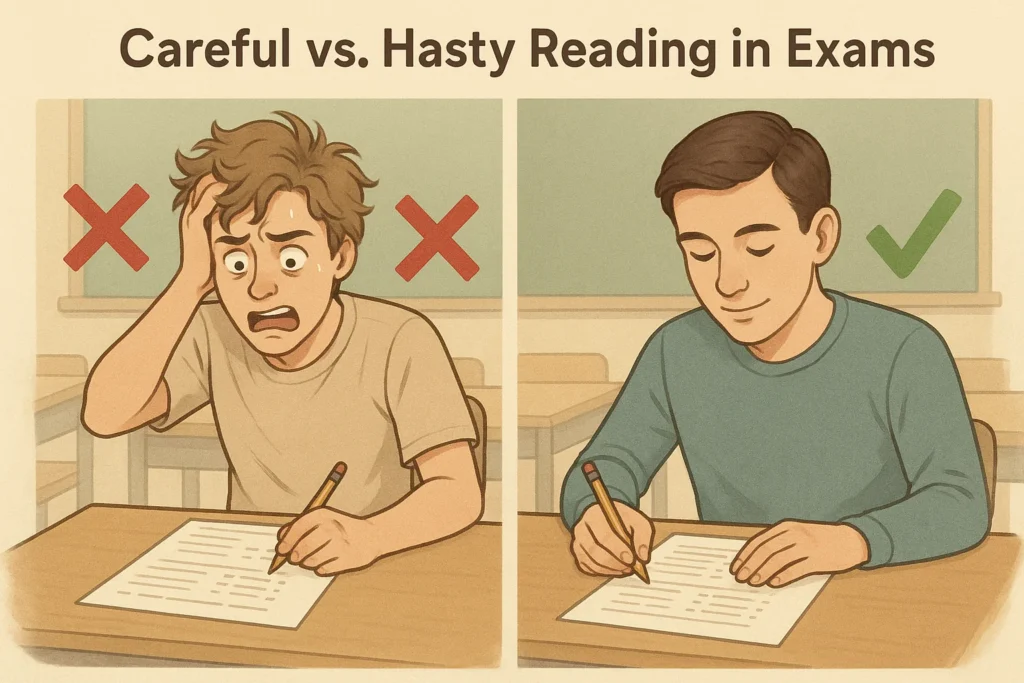
Before and After Example
| Scenario | Without Careful Reading | With Careful Reading |
|---|---|---|
| English Exam | Writes 3 points instead of 2 | Writes exactly 2 and earns full marks |
| Science Test | Misses the word “not” | Correctly identifies the false statement |
| Essay | Goes off-topic | Stays focused on the prompt |
| Debate | Misunderstands the motion | Responds with clear, relevant arguments |
The difference looks small but in performance, it’s everything.
How to Practice Daily: The 10-Second Rule
Next time you see any question exam, quiz, or even a text message pause for 10 seconds before answering.
Use that moment to ask:
- What exactly is being asked?
- Are there any key limits or conditions?
- What’s the focus word or phrase?
You’ll notice how that short pause makes your response sharper, more thoughtful, and more accurate.
Mini Story: The Quiz Bee Lesson
During a regional quiz bee, one question read:
“Which planet is known as the red planet?”
Half the students buzzed in with “Venus.” They were so focused on being fast that they ignored the word red. The correct answer, of course, was Mars.
The winning student later said,
“I didn’t know all the answers, but I read every question twice.”
That’s the lesson: careful readers win even when others know more because they understand better.
FAQ Section
Q1. What does “Read the statement carefully” mean?
It means to fully understand what a question or instruction is asking before you answer. Look for key words, limits, and tricky phrases.
Q2. How do I train myself to read carefully?
Use active reading strategies like underlining, highlighting, and paraphrasing. Practice daily with short texts or exam questions.
Q3. What type of sentence is “Read the statement carefully”?
It’s an imperative sentence, giving a direct command or instruction.
Q4. Why do students still make mistakes even after reading?
Because they read too fast or let stress take over. Rereading and slowing down improves accuracy.
Q5. Is careful reading useful outside exams?
Yes it improves communication, listening, and decision-making in real life, from school to work and relationships.
Motivational Takeaway: Slow Down to Go Faster
Sometimes, success isn’t about speed it’s about clarity.
When you read the statement carefully, you save time, avoid confusion, and answer with confidence.
It’s like checking your map before starting a journey. The few seconds you spend understanding the question prevent minutes of backtracking.
So next time your teacher says it smile, take a breath, and remember:
Smart students don’t just know answers. They know the question.
Keep practicing, stay focused, and you’ll discover how this simple skill makes you not just a better test-taker but a clearer thinker in every part of life.

Alex Smith mentors young learners in debate and writing, turning complex expression into simple strategies. He inspires students to speak with confidence and write with clarity.