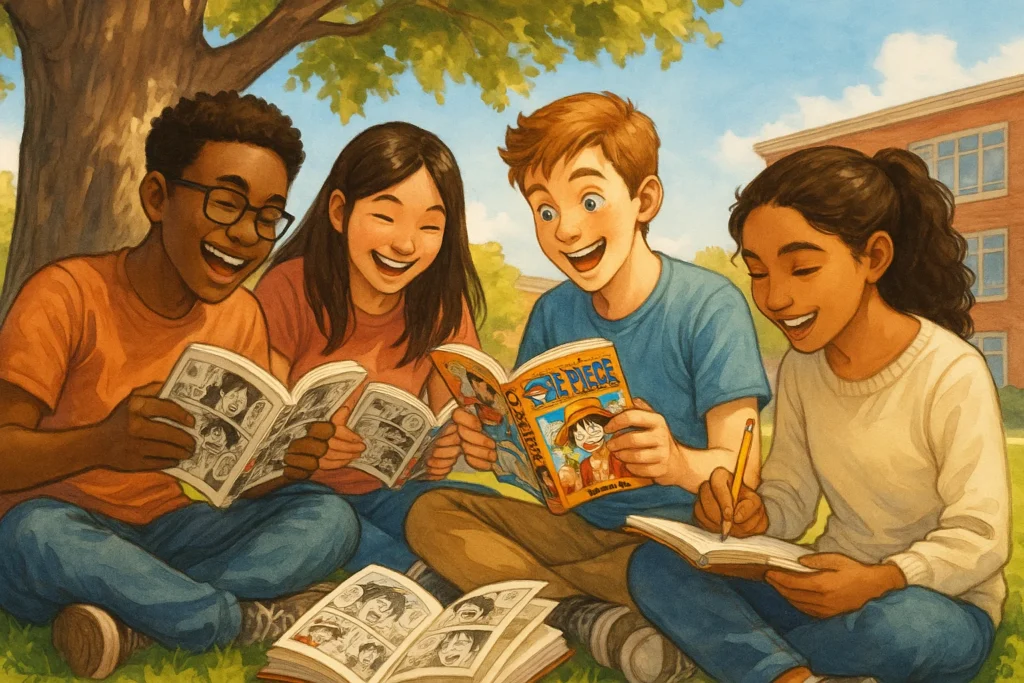
A Journey That Starts With Curiosity
When I first saw a student holding a thick black-and-white book with the word “One Piece” across its cover, I thought it was just another comic.
A week later, half the debate club was talking about pirates, dreams, and friendship. That’s when I realized: this manga isn’t just entertainment it’s an education in courage and imagination.
To read One Piece manga is to step aboard the Going Merry or the Thousand Sunny and sail with Monkey D. Luffy, a boy whose straw hat is as big as his heart. But behind the laughter and battles, One Piece teaches us something much deeper about resilience, justice, loyalty, and finding your true voice.
Let’s explore why students around the world including many here in the Philippines find this manga not only exciting but also emotionally and intellectually inspiring.
The Power of Storytelling in One Piece
Storytelling is at the heart of all learning. It helps us remember, feel, and understand. One Piece does this brilliantly.
Each arc introduces new worlds and moral lessons, but all connect to one simple idea: everyone has a dream worth fighting for. Whether it’s Sanji’s dream to find the All Blue or Nami’s wish to draw a map of the world, these stories echo the hopes of every student who has ever imagined a brighter future.
Definition Explained:
A manga (漫画) is a Japanese comic or graphic novel that uses visual art and text together to tell complex stories. Reading manga builds not just vocabulary, but also emotional intelligence through imagery and dialogue.
According to UNESCO’s 2024 Education Report, visual narratives improve comprehension among youth readers by up to 37%. That’s why many teachers now include manga in reading programs it connects literacy with curiosity.
Why Students Keep Reading Not Just Watching
You might wonder: with One Piece available as an anime, why do millions still read the manga? The answer lies in control and imagination.
When we read, we set the pace. We pause at emotional panels, imagine the voice behind each “Shishishi!” laugh, and interpret expressions in our own way. Reading is interactive thinking.
In classrooms I’ve visited, students who read manga often show stronger empathy and focus. They discuss motives, plot twists, even the ethics of certain characters. One grade-10 student told me,
“Sir Alex, when I read One Piece, I feel like I’m debating with myself what’s right, what’s fair, what’s worth sacrificing.”
That’s the kind of reflective thinking every educator dreams to spark.
Lessons in Courage and Friendship
At its core, One Piece is about courage to be yourself even when the world laughs at you.
- Luffy’s bravery teaches assertiveness without arrogance.
- Nami’s independence models self-worth and healing from trauma.
- Usopp’s lies evolve into confidence proof that growth is possible.
- Zoro’s discipline mirrors every student striving for mastery.
According to the OECD’s 2025 Learning Wellbeing Study, adolescents who engage with courage-themed fiction report 28% higher resilience scores during stressful school periods. So yes, comics can build character as much as any textbook.
“Is One Piece LGBTQ?” Understanding Inclusion in Manga
Many young readers ask this online, so let’s discuss it with respect. One Piece itself doesn’t label characters directly, but it celebrates individuality. Characters like Emporio Ivankov or Bon Clay (Mr. 2) express gender fluidity openly and are treated with friendship rather than ridicule.
That message accept difference, value heart over labels is powerful for classrooms promoting inclusion.
Teachers often use these examples to start respectful discussions about diversity, empathy, and equality.
Quick Fact:
In 2024, Japan’s Ministry of Education noted that 17% of schools introduced inclusive reading materials, and global titles like One Piece were listed among recommended media for empathy training.
So, while One Piece isn’t an “LGBTQ story,” it quietly teaches respect a lesson every young reader should learn.
The Debate Club’s Favorite Arc
Now, about those arcs! Someone always asks, “Sir, what arc is 750 in One Piece?”
Chapter 750 falls within the Dressrosa Arc, one of the series’ longest and most emotional storylines.
Dressrosa challenges ideas of power and freedom through Doflamingo’s dictatorship and the struggle of the oppressed. It’s a masterclass in moral argumentation perfect for debate practice.
Students often analyze it this way:
| Debate Topic | Example from Dressrosa | Learning Skill |
|---|---|---|
| What defines true justice? | The Marines’ conflicting orders | Ethical reasoning |
| Can lies protect people? | Usopp’s false hero tale | Persuasive writing |
| Is revenge justified? | Law’s backstory | Argument balance |
Reading such arcs trains learners to evaluate both sides the essence of critical thinking.
“Is One Piece 1127 Released?” Keeping Curiosity Alive
Yes! As of late 2025, One Piece Chapter 1127* has been released*, continuing the Egghead Island Arc. But here’s the educational insight: waiting weekly for new chapters cultivates patience and prediction skills.
In reading circles, teachers ask students to predict next-chapter events before release. This transforms fandom into literacy practice analyzing clues, vocabulary, and symbolism.
For example:
- What does the phrase “Inherited Will” really mean?
- How do flashbacks reveal moral growth?
- Which motifs repeat, and why?
Every guess becomes a mini-essay in critical reading.
Is One Piece Written by a Woman?
No, the creator is Eiichiro Oda, a male mangaka (manga artist). But the depth of his female characters often surprises readers. Nami, Robin, Hancock, and even young Tashigi show independence and intellect.
Oda once shared in an interview that he writes female characters “not to be saved, but to choose their own battles.” For young readers especially girls this representation matters. It challenges stereotypes and shows that strength is not gendered.
How Reading One Piece Improves English Skills
Many Filipino and international readers enjoy One Piece in English translation, which is great practice for language learners. Here’s why:
- Vocabulary Building:
Each chapter introduces vivid verbs (stretch, clash, soar) and idioms in natural dialogue. - Contextual Learning:
Readers infer meanings through images and tone exactly how fluency develops. - Comprehension Practice:
Following complex arcs strengthens sequence and cause-effect recognition. - Expression Training:
Students often imitate character speeches, building confidence in oral delivery.
A 2025 study by the Philippine Educational Journal showed that students who read illustrated texts weekly improved English comprehension by 22%.
So, your next “study hack” might just be reading manga!
Emotional Intelligence in Panels and Pages
Every tear that falls from Nami’s eyes or every silent panel of Robin whispering “I want to live” conveys emotional literacy.
In debates and essays, students often struggle to express feelings. Manga helps bridge that gap by modeling emotion through art.
A teacher from Cebu shared:
“When my students described how they felt about Luffy’s farewell to Vivi, their vocabulary of emotion ‘hopeful,’ ‘bittersweet,’ ‘grateful’ expanded faster than any worksheet could teach.”
That’s the unseen magic of reading: empathy grows quietly between the lines.
Turning Fandom into Learning
If you’re a teacher or parent, don’t dismiss manga as mere fun. Use it!
Here’s a mini-guide:
Classroom Ideas
1. Character Profiles:
Assign each student a character to study values, quotes, and motivations.
2. Moral Debates:
Use story conflicts (e.g., Marine Justice vs. Pirate Freedom) for critical-thinking exercises.
3. Vocabulary Journals:
List new English words per chapter; draw the scene to connect image + word.
4. Essay Prompts:
“How does friendship in One Piece reflect real life teamwork?”
5. Creative Speech:
Let students deliver short monologues inspired by Luffy’s dream speeches.
These turn reading enjoyment into measurable learning outcomes.
The Spirit of Dreams: A Lesson in Resilience
Luffy’s journey is essentially a metaphor for student life.
He starts small, faces failures, loses friends, yet keeps believing.
In the same way, students face tests, rejections, and doubt. But each challenge adds experience.
When Luffy shouts, “I’m gonna be King of the Pirates!”, it mirrors every learner’s cry: “I’ll reach my goal!”
That attitude the refusal to quit is what teachers call a growth mindset.
How One Piece Connects Cultures
The Philippines has one of the world’s largest One Piece communities. Street markets sell volumes beside textbooks; even jeepney art shows Straw Hat crews.
Manga bridges cultural gaps. Japanese storytelling meets Filipino humor, teamwork, and resilience. Readers learn not just language but worldview: that unity and dreams can overcome poverty, distance, and fear.
In education, that’s called cross-cultural literacy understanding values beyond your own nation’s borders.
From Panels to Purpose: Expressing Yourself
Alex Smith’s Writing Tip:
“Every great reader becomes a writer the moment they reflect.”
After finishing an arc, write a short journal:
- What emotion did I feel?
- Which character’s choice would I debate?
- What did this chapter teach me about courage?
Such reflection turns entertainment into expression a key goal of every English curriculum.
Study Says
A 2025 Harvard Education Review noted that graphic storytelling increases retention and creative writing output by 30%. Students who visualize stories produce richer descriptions and stronger empathy.
That’s exactly what One Piece cultivates: detailed imagination. The art invites readers to co-create the world inside their minds.
Common Misconceptions About Reading Manga
| Myth | Reality | Learning Benefit |
|---|---|---|
| Manga is childish | Many arcs tackle politics, war, and ethics | Builds maturity in interpretation |
| Manga ruins English grammar | Bilingual editions improve vocabulary | Encourages context learning |
| It’s a waste of time | Reading = focus + analysis | Enhances concentration |
When parents understand these, they start supporting reading habits instead of limiting them.
The Educational Value of Long Stories
With over 1,100 chapters, One Piece might seem endless but that’s the beauty of long-form storytelling.
Readers develop patience, attention span, and commitment skills essential for higher learning.
A student once told me,
“If I can finish 100 volumes of One Piece, I can finish my research paper.”
That’s not exaggeration it’s proof that persistence in hobbies shapes academic stamina.
Final Reflection Why We Still Sail
Reading One Piece is more than following pirates; it’s about learning to dream responsibly, to fail bravely, and to rise again with friends beside you.
When you open a manga volume, you’re not escaping reality you’re training your imagination to face it better.
So, whether you’re a student writing essays, a teacher planning lessons, or a parent nurturing curiosity, let Luffy’s journey remind you:
“Courage isn’t the absence of fear it’s the decision to keep sailing.”
Keep reading. Keep expressing.
Your voice, like Luffy’s will, is unstoppable.
FAQ
Q 1. Is One Piece LGBTQ?
It includes gender-fluid and diverse characters promoting acceptance, though it’s not categorized strictly as LGBTQ.
Q 2. What arc is 750 in One Piece?
Chapter 750 belongs to the Dressrosa Arc, exploring themes of justice and dictatorship.
Q 3. Is One Piece 1127 released?
Yes, Chapter 1127 is part of the Egghead Island Arc (released 2025).
Q 4. Is One Piece written by a woman?
No, it’s written and illustrated by Eiichiro Oda, but it portrays strong female characters who lead with purpose.

Alex Smith mentors young learners in debate and writing, turning complex expression into simple strategies. He inspires students to speak with confidence and write with clarity.