In this guide, we’ll go through everything you need to know about how to take the LTO exam from requirements and scheduling to practical tips for passing the written and actual driving test. Whether you’re a student, employee, or first-time driver, you’ll learn how to handle the process confidently.
Understanding What the LTO Does
Before we jump into exams and forms, let’s get one thing straight what exactly is the LTO?
The Land Transportation Office (LTO) is the government agency responsible for enforcing transportation laws, issuing driver’s licenses, and ensuring road safety across the Philippines. In short, they make sure every driver on the road is qualified, disciplined, and aware of traffic rules.
Quick Fact: According to the Department of Transportation’s 2024 report, over 18 million active drivers are registered in the Philippines and every one of them passed through the LTO’s licensing system.
So if you’re taking the LTO exam soon, you’re joining a huge community of drivers who once sat exactly where you are now.
Types of Driver’s Licenses in the Philippines
Before taking any exam, you need to know what kind of license you’re applying for. The LTO has specific classifications depending on the type of vehicle you plan to drive.
A. Student-Driver Permit
This is your first step. It allows you to practice driving under supervision. You can’t drive alone yet, but it’s your ticket to start learning.
B. Non-Professional Driver’s License
This lets you drive private vehicles for personal use once you’ve gained experience. It’s the most common license among students and employees.
C. Professional Driver’s License
This is for those who drive for a living like public transport drivers, delivery riders, or company drivers.
Understanding License Codes: A1, B, B1, B2
One of the questions students often ask is:
“What is A1, B, B1, or B2 in the LTO exam?”
These codes represent vehicle categories based on the size and type of vehicle you can operate. Here’s a simple breakdown:
| Code | Vehicle Type | Description |
|---|---|---|
| A1 | Motorcycle | Up to 125 cc engine; common for scooters. |
| A2 | Motorcycle | Over 125 cc; larger bikes. |
| B | Light vehicles | Cars or vans not exceeding 5 000 kg GVW. |
| B1 | Utility vehicles | SUVs, pickups, small trucks. |
| B2 | Heavy vehicles | Trucks, buses, or vehicles over 5 000 kg GVW. |
When you apply, choose the category that matches what you actually intend to drive. Applying for a code you won’t use just makes the process longer and harder.
Step 1: Secure Your Student-Driver Permit
You can’t take the main LTO exam without a student permit, so start here.
Requirements
- At least 16 years old (for non-professional)
- Medical certificate from an LTO-accredited clinic
- 1 valid ID (school ID, passport, or government ID)
- TIN (for those 18 and above)
- Theoretical Driving Course (TDC) Certificate
Once you have these, go to your nearest LTO office or driving school, submit the documents, and pay the necessary fee. After a quick photo and signature capture, you’ll get your permit the same day.
Step 2: Complete the Theoretical Driving Course (TDC)
The TDC is a 15-hour classroom training covering road signs, traffic rules, and basic vehicle handling. You can take it in an LTO Driver’s Education Center (free) or any accredited driving school (fees range from ₱1 000–₱2 000).
During the TDC, you’ll learn:
- Traffic signs and road markings
- Defensive driving techniques
- LTO laws and penalties
- Basic first-aid and safety tips
At the end of the course, you’ll receive a TDC certificate, which you must present before taking the written exam.
Step 3: Schedule Your LTO Exam Appointment
After completing the TDC, it’s time to book your exam schedule.
You can:
- Walk in at an LTO branch (earlier is better lines grow fast)
- Or book online through the Land Transportation Management System (LTMS) portal at portal.lto.gov.ph
Online Booking Steps
- Go to the LTMS portal and create an account.
- Fill out your personal information and license type.
- Choose your LTO branch and appointment date.
- Print or screenshot your appointment confirmation.
This portal also lets you check your LTO violations, fines, and exam results later so keep your account active.
Step 4: Prepare for the LTO Written Exam
The written exam is usually the most nerve-wracking part, especially for first-timers. But the good news? You can study ahead.
Exam Format (as of 2025)
- Total Questions: 60
- Passing Score: 48 for non-professional; 50 for professional
- Duration: 1 hour
- Languages: English, Filipino, Cebuano
Question Topics
- Traffic signs and meanings
- Road rules and driving ethics
- Penalties for violations
- Basic car and motorcycle maintenance
- First-aid and emergency response
Tip: Around 40% of questions come from the TDC lessons so review your notes carefully!
Study Strategies to Pass the LTO Written Exam
Here’s how to make studying simpler:
- Use LTO’s Online Practice Tests
Visit the LTMS portal’s e-learning section or check official review sites offering free mock exams. - Make Flashcards
Write traffic signs on one side and meanings on the other great for quick review. - Remember Penalties by Category
Speeding, illegal parking, reckless driving each has specific fines. Group them in your notes. - Study in Bursts
Fifteen minutes of focused study every day works better than cramming for 3 hours the night before. - Sleep Well Before the Exam
Your mind remembers more when you’re rested.
Step 5: Taking the Written Exam at the LTO
On the day of your exam, bring:
- Your Student-Driver Permit
- 1 valid ID
- TDC Certificate
- LTMS appointment confirmation
Arrive early at least 30 minutes before your slot.
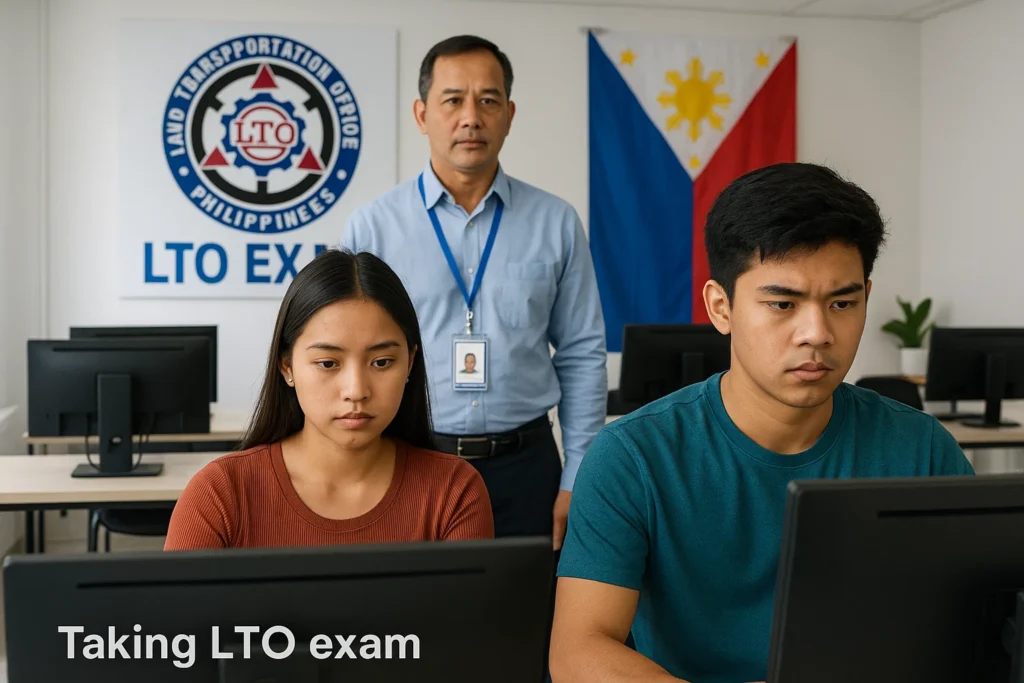
Exam Process
- Verification Desk: Submit documents for checking.
- Biometrics & Photo Capture: LTO will update your record.
- Orientation: A staff member explains the computer-based exam rules.
- Exam Proper: Answer questions using a touchscreen or desktop computer.
- Result Display: Results appear instantly after you click Submit.
If you pass, you’ll move to the practical driving test the same day (or on your scheduled date). If you fail, you can retake after one month.
Step 6: The Practical Driving Test
This is your chance to prove you can handle a vehicle safely.
What You’ll Need:
- Your own vehicle (or rent one from LTO/driving school)
- Valid Student Permit or Exam Slip
Practical Test Checklist
| Skill Tested | What They Look For |
|---|---|
| Vehicle control | Smooth acceleration, braking, clutch use |
| Observation | Checking mirrors, blind spots, signals |
| Parking | Ability to park properly within lines |
| Turning & lane discipline | Proper use of lanes, turn signals |
| Road etiquette | Respecting pedestrians and other drivers |
Passing Tip: Stay calm and follow your examiner’s instructions. Small mistakes (like stalling once) are okay unsafe habits are not.
Step 7: Pay Fees and Claim Your License
If you pass both exams, congratulations! You’re ready to claim your new LTO driver’s license.
Typical Fees (as of 2025)
| Category | Approx. Fee (₱) |
|---|---|
| Theoretical Driving Course | 1 000–2 000 (at private school) |
| Medical Certificate | 500–700 |
| Written Exam & Processing | 250 |
| Practical Driving Test | 400–600 |
| License Card Printing | 700–1 000 |
You’ll receive your temporary license first; your plastic card can be claimed after a few weeks. Always keep your receipt it serves as your official document until your card is released.
How to Check Your LTO Violation or Status Online
If you’re worried about a possible fine or just want to verify your record, here’s how:
- Go to portal.lto.gov.ph
- Log in to your LTMS account
- Click “Violations & Penalties”
- Review your driving record
The system shows all recorded violations, fines, and payment status. You can also download your official receipt (OR) and Certificate of No Violation if needed for employment or renewal.
How to Become an LTO Officer (Bonus Insight)
Some readers ask, “How can I become part of the LTO?”
To work as an LTO officer, you typically need:
- A college degree (preferably in public administration, engineering, or law)
- To pass the Civil Service Exam
- Experience in transportation or customer service
It’s a fulfilling career for those passionate about road safety and public service.
Common Mistakes First-Time Examinees Make
- Not Reviewing the TDC Modules
Many skip study sessions, assuming the test is easy. It’s not. - Panicking During the Exam
Relax read each question twice. The exam isn’t meant to trick you. - Not Knowing Basic Car Controls
During the practical test, even simple actions like using mirrors or signals matter. - Incomplete Documents
Forgetting one ID or certificate can delay your exam. Always double-check your checklist. - Not Getting Enough Sleep
A tired mind forgets simple things, even traffic signs you already know.
Tips from Successful LTO Passers
Here are some words of wisdom from new drivers who aced their exams:
Mia, 21 (student): “I took the free theoretical course at the LTO office in Quezon City. I reviewed daily for 10 minutes and passed on my first try.”
Arvin, 28 (rider): “Online mock exams really helped. Many questions in the actual test were the same!”
Diana, 34 (teacher): “During the practical test, the examiner looks for confidence, not speed. Drive safely, not fast.”
These stories prove one thing you don’t need to be perfect, just prepared.
Comparison: Written vs. Practical LTO Exam
| Aspect | Written Exam | Practical Exam |
|---|---|---|
| Purpose | Tests your knowledge of traffic laws | Tests your driving skills |
| Format | 60 computer-based questions | Real-life driving on track |
| Duration | 1 hour | 15–30 minutes |
| Location | Inside LTO office | LTO testing area |
| Passing Score/Criteria | 48/60 (non-pro) or 50/60 (pro) | No major violations or critical errors |
Both parts matter equally understanding the law keeps roads safe, and skillful driving proves you can apply that knowledge.
Frequently Asked Questions
1. How long does it take to get a driver’s license in the Philippines?
If you already have your student permit and TDC, it can take about 1–2 weeks to finish all exams and receive your temporary license.
2. What happens if I fail the LTO exam?
You can retake after one month. If you fail three times, you’ll need to re-enroll in the TDC before trying again.
3. How do I know if my LTO exam is scheduled?
Log in to your LTMS portal; your exam date and time appear in the Appointment section.
4. Can I take the exam even without a driving school certificate?
No. The TDC certificate is mandatory. It proves you completed the required training.
5. Is there an LTO exam in Filipino?
Yes! You can choose between English, Filipino, or Cebuano depending on your location.
Motivational Takeaway: Drive Your Dreams
Passing the LTO exam is more than just getting a license it’s a step toward freedom and responsibility. You’ll no longer rely on others for rides; you’ll navigate your own path.
If you’re nervous, remember this: every skilled driver started as a beginner who studied a few signs, took a deep breath, and clicked “Submit.”
You can do this too. Study smart, stay calm, and trust what you’ve learned.
Because the road to success always starts with one confident drive.

Alex Smith mentors young learners in debate and writing, turning complex expression into simple strategies. He inspires students to speak with confidence and write with clarity.